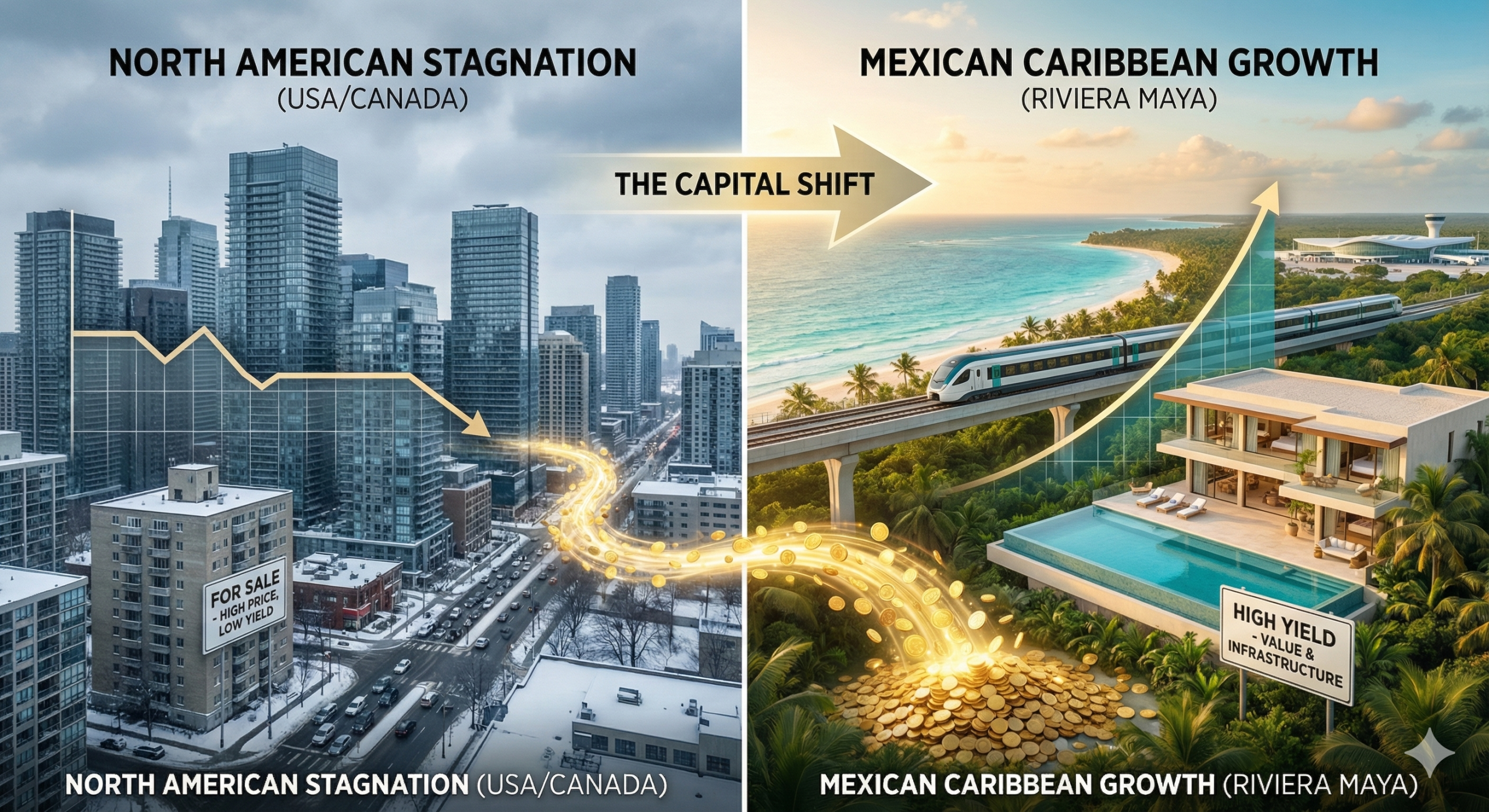
2026 Real Estate Investment Mexico vs USA: 7 Reasons Capital is Shifting South
2026 Real Estate Investment Mexico vs USA: 7 Reasons Capital is Shifting South
Table of Contents
- Introduction
- The Great Divergence: North American Stagnation vs. Mexican Growth
- Real Estate Investment Mexico vs USA: The Numbers Don’t Lie
- The “Frozen” Markets: What is Happening in the USA and Canada?
- The Riviera Maya Advantage: Infrastructure as a Wealth Catalyst
- Cost of Ownership: The Hidden Profit Killer in the North
- Legal Certainty: Why Mexico is Safer Than You Think
- Conclusion: The Window of Opportunity
Introduction
In the rapidly evolving global economy of 2026, the traditional playbooks for wealth preservation are being rewritten. For decades, the standard advice was simple: buy property in North America. However, when we analyze the current landscape of Real Estate Investment Mexico vs USA, a startling trend emerges. Smart money—institutional capital, family offices, and high-net-worth individuals—is increasingly diversifying away from the saturated markets of the north and finding a robust home in the Mexican Caribbean.
At Frank Ruiz Realty Group, we have analyzed the macroeconomic shifts driving this migration. We are seeing a distinct movement of capital from the frozen, high-interest environments of Canada and the United States into the high-yield, dynamic markets of Playa del Carmen and Tulum. This article serves as a definitive guide for investors looking to maximize their ROI and secure the best value for their money in the near future.
2026 Real Estate Performance: Mexico vs. USA
Source: Internal Market Analysis 2026 & Industry Reports
The Great Divergence: North American Stagnation vs. Mexican Growth
To understand why Real Estate Investment Mexico vs USA is currently favoring the south, we must look at the “Super Peso” phenomenon and the industrial boom known as Nearshoring. While the US and Canadian economies grapple with soft recessionary signals, Mexico has positioned itself as the manufacturing powerhouse of the Americas.
This economic strength trickles down directly to real estate. The strengthening of the Mexican economy has created a robust domestic market that supports property values, independent of tourism. Unlike the speculative bubbles we currently see in Toronto or Vancouver, the growth in the Riviera Maya is underpinned by tangible economic drivers: foreign direct investment and massive federal infrastructure spending.
Real Estate Investment Mexico vs USA: The Numbers Don’t Lie
When we strip away the emotion and look strictly at the data, the case for Mexico becomes overwhelming. An investor’s primary goal is Return on Investment (ROI). Let’s compare the metrics.
| Metric | USA / Canada (Major Metros) | Mexico (Riviera Maya) |
|---|---|---|
| Entry Price (Luxury) | $800,000 – $1.5M+ USD | $250,000 – $500,000 USD |
| Cap Rate (Long Term) | 3% – 4% | 6% – 8% |
| Vacation Rental Yield | 4% – 6% (High Saturation) | 8% – 12% (High Demand) |
| Property Taxes | 1.5% – 2.5% annually | 0.1% – 0.3% annually |
| Appreciation Trend | Stagnant / Correcting | 8% – 12% (Infrastructure Driven) |
As you can see, the Real Estate Investment Mexico vs USA comparison highlights a clear disparity. In the US, your capital is “safe” but stagnant. In Mexico, your capital is active, growing through both aggressive appreciation and superior monthly cash flow.
The “Frozen” Markets: What is Happening in the USA and Canada?
Why are investors fleeing North American real estate? The answer lies in the specific events currently unfolding in those economies.
The Canadian Housing Ceiling
In Canada, specifically in hubs like Toronto and Vancouver, the market has hit an affordability wall. Federal bans on foreign buyers and aggressive taxation on secondary homes have cooled the market significantly. Furthermore, with variable-rate mortgages hurting cash flow, many Canadian investors are currently cash-flow negative, meaning they are paying out of pocket every month just to hold the asset.
The USA Interest Rate Trap
In the United States, the “lock-in effect” has frozen inventory. Homeowners with 3% mortgages are refusing to sell, which keeps inventory low but prices artificially high. For a new investor, entering the market now means accepting interest rates that crush profitability. Additionally, the insurance crisis in key investment states like Florida and California—where premiums have tripled due to climate risk—is eroding Net Operating Income (NOI) at an alarming rate.
The Riviera Maya Advantage: Infrastructure as a Wealth Catalyst
While the US struggles with aging infrastructure, Mexico is unveiling state-of-the-art projects that directly increase property value.
- The Tulum International Airport (Felipe Carrillo Puerto): This is a game-changer for Real Estate Investment Mexico vs USA. The new airport now connects Tulum directly to major US and Canadian cities. Historically, properties near new international airports see appreciation spikes of 20% to 30% in the first five years of operation.
- The Maya Train (Tren Maya): This massive rail network connects the entire Yucatan Peninsula, moving millions of tourists from Cancun to Playa del Carmen, Tulum, and beyond. This connectivity transforms the region from a beach destination into a connected economic corridor, drastically increasing the occupancy potential for vacation rentals.
Cost of Ownership: The Hidden Profit Killer in the North
A critical factor often overlooked in the Real Estate Investment Mexico vs USA debate is the ongoing cost of holding the asset.
In the US or Canada, property taxes, HOA fees, and maintenance can consume up to 40% of your gross rental income. In the Riviera Maya, property taxes (predial) are incredibly low—often just a few hundred dollars per year for a luxury condo.
Furthermore, maintenance costs are significantly lower due to affordable skilled labor. This means your Net ROI—the money you actually keep—is far higher in Mexico. For an investor seeking value, the low holding costs in Mexico provide a safety net that simply does not exist in the high-tax jurisdictions of the north.
Legal Certainty: Why Mexico is Safer Than You Think
One of the most common misconceptions regarding Real Estate Investment Mexico vs USA is the issue of ownership safety.
In the “restricted zone” (50km from the coast), foreigners own property through a Fideicomiso (Bank Trust ). This is not a lease; it is a perpetually renewable trust held by a Mexican bank where you are the sole beneficiary. You have full rights to sell, rent, modify, or bequeath the property to your heirs.
This system is safe, transparent, and used by thousands of American and Canadian retirees and investors. In fact, it offers a level of asset protection that can be advantageous for estate planning, shielding the asset from certain liabilities in your home country.
Conclusion: The Window of Opportunity
As we look toward the future, the contrast is stark. The US and Canadian real estate markets are currently defined by high entry costs, low yields, and regulatory headwinds. In contrast, the Riviera Maya is entering a golden era defined by infrastructure maturity and rising global demand.
The best performance for your portfolio will not come from waiting for the northern markets to thaw. It will come from taking action in a market where your dollar goes further and works harder.
Ready to capitalize on this shift?
If you are ready to explore high-ROI opportunities in Playa del Carmen or Tulum, the time to act is now.
Click here to view our exclusive “Belle Âme” listings and start your investment journey.